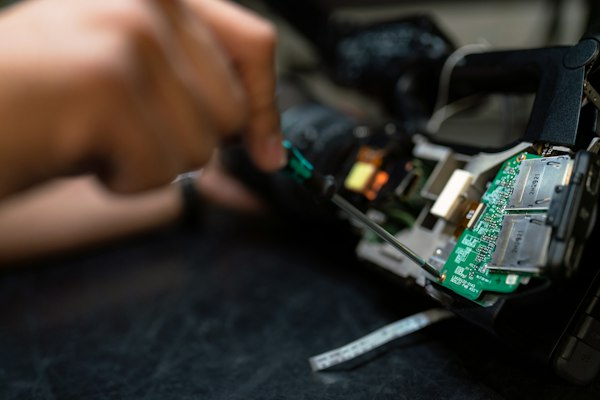
Edge AI refers to running artificial intelligence inference at or near the point where data is generated, rather than sending data to a cloud service for processing. The practical implications are significant: latency measured in milliseconds rather than seconds, no dependency on network connectivity, data that never leaves the facility, and inference costs that scale with hardware amortization rather than per-call cloud pricing. For manufacturing, retail, healthcare, and energy enterprises, edge AI is transitioning from pilot curiosity to production infrastructure in 2026.
The driver of this shift is not novelty. It is economics and capability. Small language models and purpose-built inference chips (NVIDIA Jetson Orin, Intel Neural Compute Stick, Qualcomm AI 100) now make it practical to run useful AI models on hardware that costs hundreds or thousands of dollars rather than requiring cloud GPU instances. Meanwhile, the use cases where edge processing adds material value, primarily real-time quality control, safety monitoring, predictive maintenance, and low-latency customer interactions, have expanded as model performance has improved.
12ms
average inference latency for edge AI computer vision systems in production manufacturing deployments, compared to 80 to 200ms for equivalent cloud inference via API. In applications where a defect detection system must decide whether to halt a production line, this difference is operationally material and the cloud latency is simply not acceptable.
Where Edge AI Genuinely Outperforms Cloud AI
Edge AI is not universally better than cloud AI. It is better in specific contexts that share common characteristics: real-time decision requirements, poor or intermittent connectivity, data sovereignty constraints, or cost structures at high-volume inference that favor hardware over API calls. Understanding where these conditions exist in your operations is the starting point for any sensible edge AI strategy.
Manufacturing
Visual Quality Control
42% defect detection improvement vs manual inspection
Computer vision models running on edge hardware inspect products at line speed (hundreds of units per minute) with sub-20ms inference. Cloud latency would require buffering and lose the ability to halt the line before defective products pass the inspection point. Data stays on-premises, which matters for IP-sensitive manufacturing processes.
Manufacturing
Predictive Maintenance
38% reduction in unplanned downtime in production deployments
Sensor data from industrial equipment (vibration, temperature, acoustic emissions) requires continuous monitoring at high sampling rates. Sending all raw sensor data to the cloud is cost-prohibitive at scale. Edge AI processes sensor streams locally, identifies anomaly patterns, and sends only alerts and summary statistics to the cloud for fleet-level analysis.
Retail
In-Store Analytics
No customer video data leaves the store environment
Foot traffic analysis, shelf availability monitoring, and queue management using computer vision processed entirely on-premises. GDPR and retail data governance requirements are satisfied because no customer image data is transmitted to cloud storage. Operational insights (footfall patterns, dwell times, queue lengths) are derived locally and only aggregate metrics are transmitted.
Healthcare
Point-of-Care Diagnostics
HIPAA compliance maintained without cloud PHI transmission
Medical imaging AI running on edge devices in clinical settings analyzes results without transmitting patient images to cloud services. Particularly relevant for remote or rural facilities with intermittent connectivity and for use cases where real-time results are clinically necessary. FDA SaMD considerations apply to clinical decision support applications regardless of deployment location.
Energy and Utilities
Grid and Pipeline Monitoring
Continuous monitoring without cloud dependency for critical infrastructure
AI models running on SCADA-adjacent hardware monitor grid stability, pipeline pressure, and equipment performance in real time. Operational technology (OT) environments with airgap requirements cannot route data through cloud APIs. Edge AI enables AI capability in these environments while maintaining the security posture that critical infrastructure demands.
Logistics
Autonomous Warehouse Operations
Sub-10ms navigation decision latency for AMR fleets
Autonomous mobile robots (AMRs) require real-time obstacle detection and navigation decisions that cannot tolerate cloud round-trip latency. Computer vision and path planning models run entirely on-device. Cloud connectivity is used for fleet coordination, route optimization at a higher level, and performance monitoring rather than real-time decision-making.
Cloud vs Edge AI Decision Framework
The cloud vs edge decision is not binary. Most enterprise AI architectures in 2026 are hybrid: edge inference for real-time, local, and sensitive processing with cloud for training, model management, aggregation, and complex analytical workloads. The question is which components of which applications belong at which tier.
Latency Requirement
Edge wins when real-time response is required: safety systems, line control, autonomous navigation, live inspection. Under 50ms requirements are generally only achievable at the edge.
Cloud adequate for applications tolerating 200ms to 2s response: document processing, demand forecasting, back-office automation, analytics queries.
Data Volume
Edge wins when raw data volume makes cloud transmission cost-prohibitive: high-frequency sensor streams, continuous video from multiple cameras, real-time telemetry from large equipment fleets.
Cloud adequate when data volumes are manageable: transactional data, batch processing, document analysis, structured enterprise data.
Connectivity
Edge required when connectivity is intermittent or unavailable: remote facilities, maritime environments, tunnels, OT environments with airgap requirements.
Cloud viable when reliable high-bandwidth connectivity is guaranteed, which is most urban commercial facilities and campus environments.
Data Sovereignty
Edge preferred when data cannot leave the facility: PHI in healthcare, classified or sensitive manufacturing IP, personal data with strict locality requirements under GDPR, OT data in critical infrastructure.
Cloud viable when enterprise data governance allows cloud processing with appropriate contractual protections and jurisdiction controls.
Model Complexity
Edge limited to models that fit on available hardware: SLMs up to 7B parameters with optimization, computer vision models under 500MB, purpose-built inference models. Complex reasoning and generative AI workloads generally remain cloud-based.
Cloud wins for frontier models and complex multi-step reasoning: frontier LLM applications, complex analytics, model training, and workloads requiring more compute than any edge device can provide.
Planning an AI implementation strategy that includes edge considerations?
Our
AI implementation advisory includes architecture decisions across edge, on-premises, and cloud tiers. Independent guidance with no infrastructure vendor relationships.
Enterprise Edge AI Infrastructure: What Is Required
Deploying edge AI in production requires a more integrated operational approach than cloud AI deployments. The infrastructure considerations span hardware procurement, model optimization, deployment tooling, and lifecycle management at distributed scale.
Inference hardware. The primary edge AI hardware categories are industrial AI appliances (NVIDIA Jetson Orin series for vision and compute-intensive workloads), industrial PCs with integrated NPUs (Intel AI PC and Qualcomm AI 100 platforms), purpose-built computer vision systems (Cognex, Keyence AI-enabled inspection systems for manufacturing), and mobile devices with on-device AI capability (for retail, field service, and logistics applications). Hardware selection must be matched to model requirements, operating environment (industrial vs office vs outdoor), and lifecycle management expectations. Hardware refresh cycles of 3 to 5 years are typical for edge AI deployments.
Model optimization. Models trained in cloud environments typically require optimization before deployment at the edge. Quantization (reducing precision from 32-bit to 8-bit or 4-bit) can reduce model size by 4x to 8x with minimal accuracy loss. Pruning removes less important model parameters. Knowledge distillation trains a smaller model to replicate the behavior of a larger one. The model optimization pipeline is a capability that most enterprises need to develop or contract, as it is distinct from the model training and cloud inference capabilities that data science teams typically possess.
MLOps at the edge. Managing model updates, monitoring model performance, and maintaining model quality across a fleet of potentially thousands of edge devices requires edge MLOps infrastructure. This is a materially more complex operational challenge than managing cloud model deployments, and it is one of the primary reasons that enterprises underestimate the operational overhead of edge AI programs. Our enterprise MLOps guide covers the lifecycle management requirements that apply both to cloud and edge deployments.
Edge AI deployments that succeed in pilot almost always encounter their real complexity at the point of scaling from 5 devices to 500. The model management, update, and monitoring infrastructure that seemed optional at pilot scale becomes the primary operational constraint at production scale. Build for the scale you intend to reach, not the scale you start at.
Free White Paper
AI Implementation Checklist: 200 Points Across 6 Deployment Stages
The complete pre-deployment checklist used in 200 plus enterprise AI deployments, including infrastructure, model validation, change management, and post-deployment governance requirements. Applicable to edge, on-premises, and cloud AI deployments.
Download Free →
Enterprise Edge AI: The Honest Readiness Assessment
Edge AI readiness differs from cloud AI readiness in important ways. The data infrastructure, model management, and operational technology integration requirements are distinct. The enterprises that have struggled with edge AI deployments have typically underestimated the OT/IT integration challenge, the model optimization requirement, and the operational lifecycle management complexity at scale.
Before committing to edge AI investment, organizations should assess their OT/IT integration maturity, their data engineering capability to build and maintain sensor data pipelines, their MLOps capability to manage distributed model deployments, and their organizational change management capacity to support operational technology teams adopting AI tools. The AI Readiness Assessment framework covers the infrastructure, talent, and governance dimensions that distinguish organizations ready to deploy edge AI at scale from those that will struggle at the point of production deployment.
For manufacturing enterprises specifically, the case studies that demonstrate production edge AI ROI are primarily predictive maintenance and quality control applications where the latency and connectivity requirements make edge processing necessary and the value is directly measurable in downtime reduction and scrap rates. Our manufacturing AI case study details the architecture and deployment approach for one of these programs in a Fortune 500 industrial environment.
Evaluate Your Edge and AI Implementation Readiness
Our free assessment evaluates data infrastructure, talent, governance, and use case viability for your specific industry context and operational environment.
Free Assessment →
The AI Advisory Insider
Weekly intelligence on enterprise AI including edge AI developments, implementation architecture, and production deployment insights.